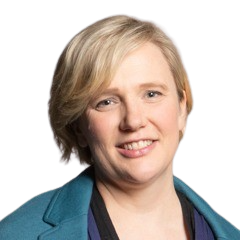
Stella Creasy is the Labour and Co-operative MP for Walthamstow, and was first elected at the 2010 general election.
In the 2024 general election, Creasy won 27,172 votes, representing 59.5% of the vote. The Green Party candidate, Rosalind Rowlands, received 9,176 votes (20.1%), while the Conservative candidate, Sanjana Karnani, secured 2,353 votes (5.2%). Creasy was duly elected with a majority of 17,996 votes.
The Walthamstow constituency is located in the London Borough of Waltham Forest in North East London. It is an ethnically diverse area which voted strongly to remain in the European Union in the 2016 referendum. While won narrowly by the Conservatives in 1987, it has become a very safe Labour seat.
Political Career
At the beginning of the parliament elected in 2024, Creasy stood unsuccessfully for election as chair of the procedure committee. In the contest, the results of which were announced in September 2024, Creasy secured 228 votes, placing second. They were eliminated in the second round. They were ultimately defeated by Cat Smith, who won the support of 301 colleagues.
Creasy served on the shadow frontbench during Ed Miliband’s tenure as Labour leader, first as shadow minister for crime prevention (2011-2013) and then as shadow minister for business, innovation and skills (2013-2015).
In 2015, Creasy stood for the deputy leadership of the Labour Party. Announcing her candidacy in an article for the Sunday Mirror, Creasy pledged to restore “fire and faith” in the Labour movement.
She said: “Too many voters think Labour is no longer a movement for social justice but a machine that only kicks in to gear at election time…
“I want to tap into the energy, enthusiasm and experience of every man and women who wants to speak up for a different Britain.
“As we watch this Tory government dismantle the welfare state, destroy the lives of our young people and demoralise the public sector, never more has Britain needed the fire for change and faith in an alternative.”
Creasy secured the support of 35 Labour MPs, winning a place on the ballot. She went on to finish second to Tom Watson with 26.4% of the vote in the final members’ vote round.
Creasy is known for several high-profile campaigns. She successfully campaigned for stricter regulation of payday loan companies, work for which she won The Spectator‘s “Campaigner of the Year” award in 2011.
In an article for the Guardian, published 3 February 2011, Creasy warned that “legal loan sharks are circling our poorest families” and urged the government to support a cross-party motion seeking to cap the total cost of lending that is being charged in the high-cost credit market.
She added: “Just six companies control 90% of the market for home credit. This means that the 7 million Britons who are excluded from mainstream banking have no choice but to accept rates that even Boris Johnson has called extortionate.”
Speaking in the House of Commons later that day, Creasy said there had been a fourfold increase in the use of payday loans since the beginning of the recession in the late 2000s. She pointed to enormous levels of interest rates being charged, in some cases ranging from 271% to 440%, and even 4,000%.
She said: “We are talking about the payday loans of £100 until the end of the month that keep getting repeated, the doorstep lending of £200 that is offered to people so that they can buy a new sofa, and the hire purchase agreements offering deals that people sign so that their kids can have a new TV.”
In 2013, George Osborne as chancellor announced a legal cap would be introduced on the overall cost of payday loans. At the time, he praised Creasy’s campaign.
At the 2015 general election, Creasy notably increased her majority in Walthamstow from 9,478 votes to 23,195 – at a time when the Labour Party went backwards nationally.
In 2017, Creasy tabled an amendment to the queen’s speech to allow women in Northern Ireland access to NHS-funded abortions in Great Britain. Following the proposed amendment, which again won cross-party support, the government announced the policy change so that Northern Irish women could access free abortions in the English NHS. Creasy said this campaign resulted in her receiving death threats.
Creasy has also been a prominent advocate for MPs’ parental rights.
In February 2021, Creasy threatened legal action against the government after they did not include all MPs in maternity cover plans. It came after the government passed a new law, the Ministerial and other Maternity Allowances Act 2021, so senior ministers do not have to resign if they have a baby. The reform was sparked by then-attorney general Suella Braverman’s pregnancy.
Creasy told BBC Radio 4‘s Today programme: “I think every woman should be able to have paid maternity cover, proper cover – it’s not just about being paid, it’s that somebody else will be doing that job – so Suella Braverman will be able to take proper leave with her child.”
She added: “I am very prepared to go to court over this, because it is a form of direct discrimination… as a backbencher, none of these provisions will apply to myself, it’s still very unclear what I can tell my constituents they can get in terms of cover”.
In November 2021, Creasy was told it was against the rules to bring a child to a parliamentary debate after attending a session in Westminster Hall with her three-month-old son. Speaking to Sky News after the reprimand, Creasy explained that she takes her child into parliament when she votes so that she can “make sure that my constituents have representation because I don’t have maternity cover”.
“If I don’t have my child with me and I don’t go in, then my residents in Walthamstow don’t get heard”, she added.
“I think it’s just a representation of how, often, if you’re a mum, you can’t win – because obviously if I had maternity cover it would be a different issue, but I don’t and I don’t want to short-change my residents.”
Creasy’s criticism prompted a review of the rules by the procedure committee, ordered by House of Commons speaker Sir Lindsay Hoyle. The review, reporting in June 2022, ruled that the “long-standing practice” of barring babies from parliamentary debates should remain in place. Creasy expressed her disappointment in the findings, saying: “This committee didn’t speak to a single person outside parliament, despite many of us encouraging them to do so.
“So I’m not surprised they don’t recognise who is put off parliament by its antiquated rules. Change will only come when we start listening to those outside the status quo.”
She was a member of the House of Commons public accounts committee from 2010 to 2011, and the science, innovation and technology committee from 2015-2017.
Creasy delivered her maiden speech on 2 June 2010 during a debate on education and health. In it, she said: “The Labour party understands that when we invest in the future of every young person in Britain, wherever they live, we all benefit.
“That is why I give notice to those on the government benches: on behalf of the people of Walthamstow and their families, I intend to fight for every place, every opportunity and every chance that my community wants and deserves; to challenge the government’s proposals that will mean a bleaker, not a brighter, future for them; to use my place in the House to be a voice for those who will be forgotten by the government’s proposals; and to argue that there is not simply opposition to the government, but an alternative.”
Before becoming an MP, Creasy served as a Labour councillor for the Lea Bridge ward on Waltham Forest Council from 2002 to 2006, including for periods as deputy mayor and mayor.
Political views
In an interview with the New Statesman, at the time of her deputy leadership bid (2015), Creasy set out a vision for a less factional Labour Party. “We can’t afford to waste anyone in the Labour party,” she said. “Most of my adult life in the Labour party it has been Brownite, Blairite, Trot. . . It’s a machine on all sides that says ‘unless you can conform to our gang, we’re not interested in working with you’. That has got to stop.”
In a later interview with the Times, published August 2015, Creasy added: “I don’t do tribes, I don’t play the traditional game.”
Asked if she would serve in a Labour shadow cabinet led by Jeremy Corbyn, she responded: “Of course I would, because that process of rebuilding isn’t about any one person it’s about all of us. It’s written on the back of our membership card that we achieve more together than we do alone.”
Pressed on whether she would consider herself as on the left, Creasy commented: “It’s not a question of left or right for me but about activism”.
The challenge, she said, was to be “relevant”.
“People are questioning not whether we’re left or right but what’s the point of us at all? There is no rule in the British constitution that says there has to be a Labour party; there is no rule that requires us to be the official opposition, so come what may, we’ll always be there. I’m looking at 2020, I’m looking at the world to come.”
Leadership elections and loyalty
Labour deputy leadership 2025: Creasy was one of 24 Labour MPs who nominated Bell Ribeiro-Addy for the party’s deputy leadership in September 2025. The election followed the resignation of Angela Rayner, who stepped down as deputy prime minister and deputy party leader after an investigation into her tax affairs. It marked the first time since 2007 that Labour had held a deputy leadership contest while in government.
Ribeiro-Addy, a member of the Socialist Campaign Group (SCG), was seen as the candidate on the left of the party. She secured only 24 nominations from the Parliamentary Labour Party (PLP), far short of the 80 required under rules introduced in 2021.
Labour leadership 2015: Creasy, who was running for deputy leader, was one of 26 Labour MPs who did not nominate any candidate for the party’s leadership in June 2015. The election was triggered by the resignation of Ed Miliband following the 2015 general election defeat and was the first to be conducted under the “one member, one vote” system. The contest eventually saw Jeremy Corbyn, a veteran backbencher, win a landslide victory in the first round with 59.5% of the vote, defeating Andy Burnham, Yvette Cooper and Liz Kendall.
Corbyn loyalty list: In March 2016, Creasy was labelled as “hostile” by the Corbyn leadership in a leaked list which categorised Labour MPs by their perceived loyalty. This label suggested the Corbyn leadership viewed Creasy as actively and openly antagonistic.
Following the EU referendum, which saw Corbyn criticised for his perceived lack of enthusiasm, Creasy suggested the Labour leader’s performance was “unforgivable”. In an op-ed for the New Statesman, published July 2016, Creasy wrote: “Labour needs each of us to put our very all – our 10 out of 10, not 7.5 – into achieving our aims. Each of us [asks] the public to take sometimes difficult steps with us because we believe it is in the best interests of the country. That is why I have no confidence in Jeremy Corbyn any more.
“It is unforgivable to have a leader who, when faced with Brexit and the damage it could do, asked others to go on to the pitch while he benched himself.”
Labour leadership 2016: Creasy initially supported Angela Eagle for the party’s leadership in July 2016. The election was triggered by a challenge to Corbyn following the EU referendum. Eagle, the former shadow first secretary of state, was the first to formally launch a challenge against Corbyn. However, she withdrew from the race on 19 July after attracting fewer nominations than Owen Smith. Corbyn was ultimately re-elected an increased mandate of 61.8% of the vote.
After Eagle withdrew from the race, Creasy backed Owen Smith.
Creasy was a notable and consistent critic of Corbyn’s leadership of the Labour Party. In November 2015, one month after Corbyn assumed office, Creasy said the promise to embrace a “new politics” had not been delivered. A backbencher at the time, having not been appointed to the Labour frontbench, she told the Guardian: “Yeah, I’m still waiting for that to happen.”
Labour leadership 2020: Creasy was one of 31 Labour MPs who nominated Lisa Nandy for the party’s leadership in early 2020. The election was triggered by the resignation of Jeremy Corbyn following the party’s defeat in the 2019 general election, which resulted in Labour’s fewest seats in the House of Commons since 1935.
Nandy, the MP for Wigan, argued that the party needed a “bridge” to reconnect with traditional working-class voters in northern England. She finished third in the contest with 16.2% of the vote
https://x.com/stellacreasy/status/1216727430930538497
Labour leadership 2010: Creasy was one of 81 Labour MPs who nominated David Miliband for the party’s leadership in May 2010. The election followed the resignation of Gordon Brown, who stepped down as prime minister and Labour leader after the 2010 general election.
Miliband, the former foreign secretary, was seen as closely aligned with the New Labour project – a Blairite figure. He secured 81 nominations from the Parliamentary Labour Party (PLP), comfortably exceeding the 33 required to reach the final ballot, but was narrowly defeated by his brother, Ed Miliband, in the final round by 50.7% to 49.3%.
Factional identity and party tradition
Labour Movement for Europe: Creasy is national chair of the Labour Movement for Europe (since February 2022). Founded in 1981, LME is a pro-European socialist society affiliated with the Labour Party. It campaigns for a close relationship between the United Kingdom and the European Union. The organisation refers to itself as the “home of the pro-Europeans in the Labour and trade union movement”.
Usdaw: Creasy is a member of the Usdaw Union Parliamentary Group – a group of MPs who are members of the Union of Shop, Distributive and Allied Workers (Usdaw) and work generally to represent the union’s interests within parliament.
SERA: Creasy has been listed as a member of the Socialist Environment and Resources Association (SERA) – a socialist society affiliated with the Labour Party. Founded in 1973, SERA is the party’s official environmental campaign group. The organisation campaigns on a wide range of issues, including renewable energy, biodiversity, air quality and the transition to a green economy. SERA describes its member MPs as “champions for the environment”.
Brexit and Europe
Brexit referendum: Creasy supported Remain in the 2016 Brexit referendum, and therefore agreed with a majority of constituents, 66.5% of whom also voted to Remain
Article 50: In February 2017, Creasy voted against the European Union (Notification of Withdrawal) Bill. The legislation empowered the prime minister to notify the Council of the European Union of the UK’s intention to withdraw, formally triggering the process set out in Article 50 of the Treaty on European Union. MPs supported the bill by 498 votes to 114 at second reading. In voting against the bill, Creasy defied the party whip – one of 47 Labour MPs to do so.
Brexit trade deal: In December 2020, Creasy was among the 37 Labour MPs to rebel against the leadership’s position on the EU (Future Relationship) Bill – which enabled the government to implement and ratify its post-Brexit trade deal with the EU. Keir Starmer, the newly elected Labour leader, argued that while the trade deal negotiated by Boris Johnson’s government was “thin” and flawed, the only alternative at that late stage was a “no-deal” exit. To enforce the leadership’s position, a three-line whip was imposed. Creasy abstained over the bill. One Labour MP, Bell Ribeiro-Addy, voted against the bill.
Rejoin debate: In March 2025, Creasy participated in a Westminster Hall debate on a public petition calling for the United Kingdom to rejoin the European Union as a full member. The debate was triggered by an e-petition signed by over 128,000 people.
In the debate, Creasy described Brexit as a ” disaster”.
She said: “Brexit is a disaster. It is a disaster by anybody’s metric, not least those according to whom it was purported to be a route to the promised land. The pandemic spared some of the blushes of those who still try to claim that we have got some elusive sovereignty as a result of leaving the European Union, but we can see the damage. Our constituents can see the damage…
“Those of us who are passionate about our relationship with Europe and what is possible – I stand here as chair of the Labour movement for Europe—hold our constituents in our hearts, and they need us to do what we can in the next 18 months, or else the damage that Brexit has done to the country will be so irreparable that there will be little left to negotiate.”
Electoral reform
Electoral reform amendment: In May 2026, Creasy was one of over 70 Labour MPs who signed an amendment to the Representation of the People Bill, calling on the government to establish a “national commission on electoral reform”. Tabled by Alex Sobel as chair of the fair elections APPG, the amendment aimed to force a rethink of the first past the post voting system.
At the time, Sobel described FPTP as “one of the biggest examples of a broken status quo in UK politics.” He invited colleagues to join this “common sense call to take a fresh look at how parliament is elected in modern Britain.”
Proportional representation bill: In December 2024, Creasy voted in favour of the Elections (Proportional Representation) Bill – introduced by Liberal Democrat frontbencher Sarah Olney under the 10-minute rule procedure. The bill sought to “introduce a system of proportional representation for parliamentary elections and for local government elections in England”.
A total of 138 MPs supported the bill – with 136 opposed. Notably, 59 Labour MPs backed Olney’s bill.
Introducing the bill, Olney told the House: “First past the post is a broken and unfair system. This summer, the Labour party won a landslide election victory, securing 63% of seats in the House of Commons in return for just 34% of the vote.
“The system leaves millions of voices unheard and creates a divisive, adversarial political climate where collaboration is discouraged and accountability is often sidestepped.”
Welfare
Welfare ‘reasoned amendment’ (June 2025): Creasy was one of the over 120 Labour MPs to sign the reasoned amendment to the government’s flagship welfare bill which aimed to reject the proposed legislation.
The amendment, in the name of senior Labour MP Dame Meg Hillier, objected to the fact that the bill had not been subject to a “formal consultation with disabled people” and that “250,000 people will be pushed into poverty” as a result of it, according to a government impact assessment.
The motion also called on the government to wait for the publication of the review into the Personal Independence Payment (Pip), helmed by minister Sir Stephen Timms, and the independent review, conducted by Sir Charlie Mayfield, into how the employment of disabled people could be boosted.
In May, Creasy had signed a letter warning the government that the cuts were “impossible to support” and calling for a change in direction.
The letter, signed by 42 Labour MPs, read: “The planned cuts of more than £7bn represent the biggest attack on the welfare state since George Osborne ushered in the years of austerity and over 3 million of our poorest and most disadvantaged will be affected.
“Whilst the government may have correctly diagnosed the problem of a broken benefits system and a lack of job opportunities for those who are able to work, they have come up with the wrong medicine. Cuts don’t create jobs, they just cause more hardship.”
Creasy herself suggested that the government’s initial proposals “will breach our obligations under the UN convention on the rights of persons with disabilities.”
https://www.instagram.com/p/DLk_tAzIjs_/
Welfare vote (July 2025): She went on to vote against the bill at second reading. The vote came after ministers agreed to significant concessions to avoid defeat via a mass rebellion of Labour MPs on 1 July 2025.
Assisted dying
Creasy voted in favour of the Terminally Ill Adults (End of Life) Bill, better known as the assisted dying bill, at both second reading (November 2024) and third reading (June 2025).
https://x.com/stellacreasy/status/1936338984663498879
Social values and conscience issues
Abortion decriminalisation (2025): In June 2025, Creasy tabled an amendment to the Crime and Policing Bill which sought to decriminalise abortion up to 24 weeks, negating elements of the Abortion Act. It also aimed to ensure that late-term abortions outside the Abortion Act did not result in prison sentences. The amendment was publicly supported by 108 MPs. However, it did not go to a vote after MPs backed a rival amendment proposed by fellow Labour MP Tonia Antoniazzi.
Antoniazzi’s amendment sought to remove “women from the criminal law related to abortion”, meaning “no offence is committed by a woman acting in relation to her own pregnancy”
Creasy argued that Antoniazzi’s amendment would not stop the authorities investigating “the partners of people who had an abortion or the medics who provided the abortions, and it would not prevent demands for women to give evidence as part of that process”.
Speaking to her amendment in the 17 June 2025 commons debate, Creasy said: “I think we all agree that there is a concern about vulnerable people and abortion law in this country. We disagree about how to address those concerns.”
She added: “If we think that the reason why we face these challenges are that we have these outdated laws in this country, then why would we retain them in any shape or form, rather than learning from what is best practice around the world for all of our constituents?”
Creasy ultimately voted in favour of Antoniazzi’s backbench amendment, which was passed by a majority of 242 votes.
Same-sex marriage (2013): In February 2013, Creasy voted in favour of the Marriage (Same Sex Couples) Bill at its second reading. The landmark piece of legislation, which received its second reading by 400 votes to 175, legalised marriage for same-sex couples in England and Wales.
Foreign policy and security
Sanctioned (Russia): In April 2022, Creasy was among the group of MPs placed on a sanctions list by the Russian government. The measure barred them from entering Russia and was presented by Moscow as a retaliatory response to the UK’s stance on the invasion of Ukraine.
Trident renewal (2016): Creasy voted in favour of a government motion calling for the renewal of the Trident nuclear deterrent system in July 2016. The motion, which was passed by 472 votes to 117, committed the UK to constructing a new fleet of submarines to carry the nation’s nuclear weapons. Labour was split over the issue with 140 of its 230 MPs going against leader Jeremy Corbyn and backing the motion.
Syria airstrikes (2015): Creasy voted in favour of a government motion to extend UK airstrikes against Isis from Iraq into Syria in December 2015. The motion, which was passed by 397 votes to 223 after a 10-hour debate in the House of Commons, authorised the RAF to conduct strikes against Isis targets in Syria.
Syria airstrikes (2013): Creasy voted against the government’s motion on the principle of military intervention in Syria in August 2013. The government motion was defeated by 285 votes to 272, a move which effectively ruled out UK participation in any US-led military strikes.
Palestine
Ceasefire vote (November 2023): Creasy was among 56 Labour MPs to vote in favour of a Scottish National Party (SNP) amendment to the King’s Speech in the House of Commons calling for an “immediate ceasefire” in Gaza – defying the instruction set out by the party’s frontbench. Labour had tabled its own motion, making a more moderate appeal for a “humanitarian pause” in the conflict and ordered its representatives to support that stance.
Palestinian recognition vote (2014): In October 2014, Creasy was one of 192 Labour MPs who voted in favour of recognising Palestine as a state. The motion, passed by 274 votes to 12, called on the government to “recognise the state of Palestine alongside the state of Israel as a contribution to securing a negotiated two-state solution”.
Before Politics
Born Stella Judith Creasy on 5 April 1977 in Sutton Coldfield, West Midlands, she grew up in Manchester and later Colchester. Her father was an opera singer and her mother a headteacher at a special needs school.
She attended Colchester County High School for Girls.
She joined the Labour party in 1994, aged 17.
She was an intern at the Fabian Society in the “dying days of the [John] Major government”.
She studied Social and Political Sciences at Magdalene College, Cambridge (BA). She later earned a PhD in Social Psychology from the London School of Economics (LSE) in 2006. Her doctoral thesis was titled “Understanding the lifeworld of social exclusion“.
Before her election to parliament, Creasy worked as head of public affairs and campaigns at the Scout Association.
She previously worked as a researcher and speechwriter for Labour ministers including Charles Clarke and Douglas Alexander and was deputy director of the Involve think tank.
Personal Life
Creasy’s partner is Dan Fox, a former director of Labour Friends of Israel.
She has two children, a daughter born in 2019 and a son born in 2021. She is a practising Anglican.
Trivia
In 2019, Creasy became the first MP to be given locum maternity leave cover, after a battle with the parliamentary authorities. “Locum” is a word most often used in the medical profession to describe a doctor who is covering the duties of another physician while they are ill or absent from work for some other reason.
The “locum MP”, Kizzy Gardiner, covered constituency work in Walthamstow over seven months but did not attend parliamentary debates.
Stella Creasy has not written for Politics.co.uk.