North Korea – Overview
The Democratic People’s Republic of Korea (DPRK), commonly referred to as North Korea, occupies the northern part of the Korean Peninsula, bordering China and Russia to the north, and South Korea to the south. Its capital is Pyongyang.
Often described as a totalitarian isolationist state, it is led by the Korean Workers’ Party (KWP) and its government adheres to the Juche philosophy of self-reliance introduced by the country’s first President, Kim Il-sung.
From its inception in 1948, North Korea has had three leaders all from successive generations of the Kim dynasty. After Kim Il-sung died in 1994 he was declared, and continues to retain the title of, Eternal President of the DPRK.
Kim Il-sung was succeeded by his son, Kim Jong-il who died in 2011 and he in turn was succeeded by his son, Kim Jong-un, the present leader.


North Korea is a heavily militarised country, maintaining one of the largest armies in the world. It is also a nuclear state and a member of the United Nations.
Many of North Korea’s citizens are reported to live in absolute poverty. On a number of occasions the country has been ravaged by horrific famine and severe food shortages.
North Korea’s human rights record has also attracted widespread concern for some time. The country’s leaders continue to insist that reports from the United Nations around very serious and continuing human rights abuses, are without foundation.
In June 2021, it was claimed that North Korea had introduced a new law which sought to further stamp out foreign influence, clamping down on anyone possessing foreign films and clothing. The BBC carried reports that people were being shot for being caught with South Korean dramas, with whole neighbourhoods being ordered to watch these executions by the State.
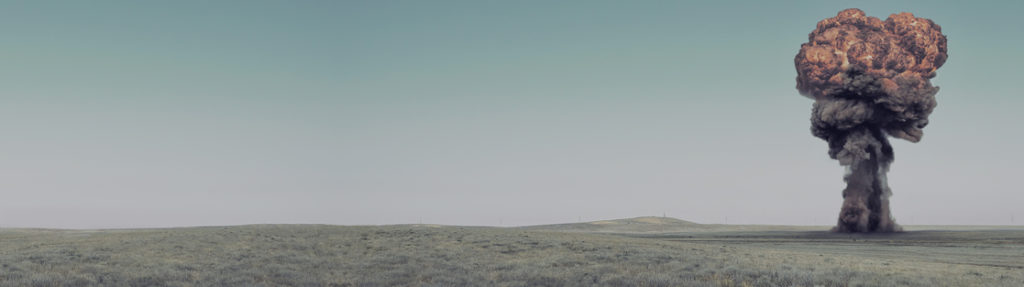
North Korea has undertaken a number of nuclear tests in the last decade.
North Korea as a nuclear power
The period before Kim Jong-Un
North Korea began a civil nuclear programme, with Soviet assistance, in the 1960s – and is believed to have begun to militarise its nuclear research in the 1980s.
In 2002, United States president George W. Bush, in his State of the Union Address, famously labelled North Korea part of an “axis of evil” which also included Iran and Iraq. Specifically President Bush said, “States like these, and their terrorist allies, constitute an axis of evil, arming to threaten the peace of the world”, adding, “By seeking weapons of mass destruction, these regimes pose a grave and growing danger.”
In 2002, North Korea backed out of a 1994 agreement to shut down its nuclear plants – and in 2003, informed the US and China that it had nuclear weapons.
In July 2006, North Korea tested one long-range and five medium-range missiles. However, the long-range Taepodong-2 missile crashed after less than a minute.
Two months later, the government claimed to have detonated a nuclear bomb at an underground test site. The secretive nature of the state meant no definitive figures were available on the strength of the explosion, but it was condemned by all members of the UN Security Council, including China.
However, South Korea, China and Russia ruled out the possibility of military retaliation and the Security Council instead agreed resolution 1718, imposing economic and military sanctions on North Korea.
In February 2007 an agreement was finally reached in the Six Party Talks, begun in 2003 between North Korea, South Korea, China, Japan, Russia and the US. Under the agreement, the US would remove North Korea from its list of terrorist states (which also included Syria, Sudan, Cuba and Iran) in return for nuclear disablement.
But the deal was beset with difficulties and in October 2008 North Korea stated that it had halted the dismantling of its nuclear programme because it had still not been removed from the terrorist blacklist. President Bush, in order to salvage the deal, then announced that North Korea had been delisted in return for verification of the country’s nuclear declaration.
However, many members of Mr Bush’s own party, including then presidential candidate Senator John McCain, remained unconvinced that North Korea would follow through and co-operate fully with the nuclear verification programme. The Democrats too, whilst welcoming the move, were equally sceptical about North Korea’s commitment to the deal.
As it turned out, they were right. In May 2009, North Korea carried out a second underground nuclear test. The UN Security Council condemned the test “in the strongest terms” and unanimously adopted resolution 1874 to tighten sanctions against North Korea, widening the ban on arms imports-exports, and calling on Member States to search North Korean ships and “seize and destroy” any banned cargo. North Korea responded by stating that it was continuing with its uranium enrichment programme.
Tensions between North and South Korea were raised again in November 2010 when the North fired an artillery barrage on the Southern island of Yeonpyeong killing two marines and two civilians. The island is reported to be used as a military base by South Korean troops and North Korea claimed it was provoked into the attack when South Korea carried out artillery drills within Northern territorial waters.
The initial years of Kim Jong-Un (2011 to 2015)
The confirmation of Kim Jong-un as the new leader in 2011 initially raised hopes for more amicable relations between the North Korea and the West. In March 2012, North Korea agreed to suspend its uranium enrichment programme and long-range missile tests in return for substantial food aid from the US.
However, in April of that year, North Korea carried out a long-range rocket launch with the aim of putting a satellite into orbit to mark the centenary of the country’s founder, Kim Il-sung. The launch failed, but the move was seen by many in the West as a breach of the agreement to suspend missile tests.
In response the American President, Barack Obama’s said in a speech at Burma’s Rangoon University, in 2012, “To the leadership of North Korea I have offered a choice: Let go of your nuclear weapons and choose the path of peace and progress. If you do you will find an extended hand from the United States of America”.
The calls though appeared to go on deaf ears and in 2013 North Korea’s National Defense Commission said it would continue nuclear testing and long range rocket launches, which it said would target the United States, “the sworn enemy of the Korean people”.
The country then undertook its third nuclear test, the first under Kim Jong Un, which led to additional sanctions being imposed by the United Nations.
In 2016, North Korea claimed to have conducted a hydrogen bomb test, and to have developed miniature nuclear warheads that could fit on ballistic missiles. In September 2016, North Korea claimed to have detonated a nuclear warhead in a blast that South Korea’s Meteorological Administration estimated had the explosive power of 10 kilotons.
2016 to 2020 – Kim Jong Un and Donald Trump
In 2017, North Korea conducted two further intercontinental ballistic missile tests and a sixth nuclear weapons test. The North Korean regime looked like it was making notable steps towards developing a nuclear weapons capability that might one day be able to hit the US mainland.
UN sanctions against North Korea were tightened further, and in his characteristic style, US President Donald Trump called on North Korea to abandon its nuclear weapons programme and warned of “fire and fury like the world has never seen”.
However somewhat unexpectedly in 2018 there was an improvement in the mood. With both sides appearing to cool the rhetoric, in April 2018 North Korean President Kim Jong-un announced a moratorium on intercontinental ballistic missile and nuclear tests.
Donald Trump and Kim Jong-un then held three face to face meetings, first in Singapore in June 2018, in Vietnam in February 2019, and then again in June 2019 in the Demilitarised Zone which divides North Korea and South Korea.
Although reducing the tension at the time, the summitry ultimately failed to resolve the nuclear issue. The United States wanted total denuclearisation by North Korea before UN sanctions could be lifted, whilst North Korea called instead for the denuclearisation of the Korean peninsula, and a ‘step by step’ process in which sanctions would be lifted as it moved towards denuclearisation.
In December 2019 at a Central Committee meeting of the Korean Workers Party, President Kim announced that North Korea was abandoning its moratorium on nuclear and intercontinental ballistic missile testing. He now called for “positive and offensive measures” to safeguard the country’s “sovereignty and security”.
The position since 2021
According to the Stockholm International Peace Research Institute, as of 2021, North Korea was estimated to have between 30 and 40 nuclear warheads.
International commentators continue to speculate as to the right approach to North Korea.
The tightening of sanctions in 2017 was said to have significantly hampered the already weak North Korean economy, one in which the country’s military and security structures consumes a significant proportion of national output. The United Nations had estimated that 40% of the population were in “urgent need” of food assistance – and – that was prior to the 2020/21 global coronavirus pandemic.
With North Korea closing its borders during the pandemic, and its trade with China (which is said to account for 90% of North Korea’s trade) slowing considerably, the food crisis in the country is said to have worsened markedly.
Speaking at a party conference, President Kim has already warned of hard times and made a comparison with the 1990s famine, one which the North Korean government claim killed 225,000 North Koreans, and which some outside commentators suggest cost between 2.5 and 3.5m million lives.
Accordingly some experts suggested that President Kim is focussed on the country’s ailing economy, meaning the country’s nuclear programme could be up for negotiation. They use this approach to suggest the sanctions regime is working and should continue.
Others by contrast, suggest that the impact of UN sanctions falls on ordinary people in North Korea, rather than being felt by the country’s leadership on which they are targeted. They suggest that with its military traditions, the loss of the country’s nuclear programme would constitute too big a loss of face for the county’s leadership. Parallels are drawn with the Gaddafi regime in Libya, which was toppled not long after it abandoned its own nuclear programme.
Moreover, people worry that the economic and social turmoil inflicting North Korea, could lead to even greater unpredictability in the activities of its governing regime.
Upon coming to office in early 2021, the new American President Joe Biden answered Yes’ to the suggestion that North Korea represented America’s biggest foreign policy threat.
The Biden Administration has gone ahead with fresh military exercises with South Korea, exercises that had previously been cancelled by Donald Trump. Although saying he is ‘prepared for some form of diplomacy’, Biden has made it clear that it ‘has to be conditioned upon the end result of denuclearization’.
The approach of the British government
Throughout the Twenty First Century, successive UK governments have closely aligned their stance with that of the United States administration.
During the course of 2018 and 2019, the UK provided Four Royal Navy vessels for a US-coordinated maritime sanctions enforcement operation.
In 2019, the Frigate HMS Montrose, was reported by the Ministry of Defence to have “successfully tracked an illegal fuel transfer at sea while conducting United Nations sanctions enforcement against North Korea”.
The history of North Korea
Early Years
The country of Korea has a proud and ancient history. People are believed to have inhabited the Korean Peninsula some 500,000 to 700,000 years ago. According to Korean history, the first Korean kingdom, Gojoseon, was established in 2333 BC by the legendary Dangun, founder of the Korean people.
Korea was often referred to as a ‘Hermit Kingdom’ remaining fiercely independent over many years, opposing any integration with the West and looking to China for protection.
However, following China’s defeat in the Sino-Japanese War 1895 and Japan’s triumph in the Russo-Japanese War 1905, Japan increased its influence over Korea, and in 1910, formally annexed the whole Korean Peninsula and colonised the country.
Post the Second World War
Following Japan’s defeat in World War II, Japanese occupation of Korea ended in 1945 and the country was partitioned; the US occupied Korea south of the thirty-eighth parallel and Russia occupied Korea north of the thirty-eighth parallel.
Kim Il-Sung, then a major in the Soviet Army, was put in charge of forming a Stalinist government in North Korea.
In 1950, North Korea invaded South Korea – beginning the Korean War, which lasted until 1953 and was one of the ‘hottest’ episodes of the Cold War. From 1953, Kim Il-Sung created an austere, militarised and highly regimented North Korean society which worshipped him as a deified leader.
Despite the Armistice Agreement signed in 1953 under which North Korea and South Korea agreed to a cease-fire, enmity still exists between the two and today, huge numbers of troops continue to face one another across the Korean Demilitarised Zone.
North Korea Today
The DPRK is one of the most secretive and insular countries in the world. It has a long history of refusing to deal with the outside world.
The unpredictability ascribed to the North Korean leadership, its possession of nuclear weapons, ballistic missiles and other weapons of mass destruction, its belligerent intentions towards South Korea and the desperation of its population, lead the DPRK to be perceived in many quarters as one of the most serious sources of international threat in the world.