What is MI6?
MI6, properly known as the Secret Intelligence Service (SIS), is the UK’s external intelligence agency, responsible for protecting and promoting British interests and security overseas. One of the methods by which it does this is espionage.
Although the “MI” in MI6’s informal title stands for “Military Intelligence”, the SIS is a Crown Service that is formally responsible to the Foreign and Commonwealth Office.
The employer of the world’s most famous fictional British spy, James Bond, MI6 is a highly secretive organisation, whose work remains shrouded in mystery – much more so than its domestic security counterpart MI5.
MI6 is based in its own distinctive building at Vauxhall Cross in London. In both the fictional James Bond Films, ‘The World is Not Enough’ and ‘Skyfall’, the building is attacked by terrorists. The use of the building in this way, was the subject to criticism from Sir Richard Dearlove, who was the head of MI6 from 1999 to 2004


Some 3,600 MI6 staff are said to work out of the famous MI6 building on the Thames.
MI5 vs MI6?
- MI5 and MI6 are both intelligence agencies of the UK government, but there is a crucial difference.
MI5 is responsible for protecting UK citizens and interests at home, notably against threats to national security. By contrast, MI6 (also referred to as the Secret Intelligence Service) is responsible for gathering intelligence outside the UK in support of the government’s foreign and defence policies.
- Where MI6 (SIS) is based in the iconic building on the Thames at Vauxhall and answerable to the foreign secretary, MI5 is based separately in another building (Thames House) and answerable to the Home Secretary.
-
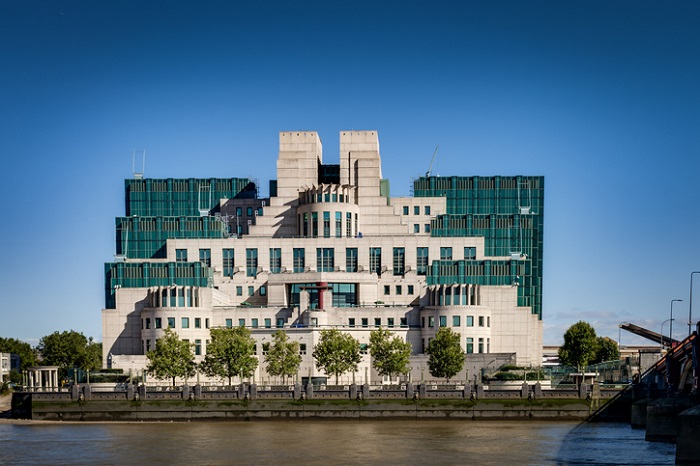
The MI6 building on the Thames.
The history of MI6
MI6 has its origins in the Secret Service Bureau, founded in 1909 to control the UK’s intelligence activities. Originally split into naval and army sections, these branches rapidly came to focus on overseas and domestic security respectively. This division was formalised with the separation of the Secret Intelligence Service in 1911. The “MI” designations were introduced in 1916, with the organisations’ transfer to the Directorate of Military Intelligence.
In the run-up to and during the First World War, MI6’s attention was focused on the German threat, but it was largely unsuccessful in infiltrating that country. It had more success in penetrating Russia: when the Bolshevik threat became apparent, MI6 provided funding to the Kerensky government. After the Russian Revolution of 1917, an MI6 agent, Sidney Reilly, was involved in a plot to assassinate Lenin.
After the Russian Revolution, the threat posed by communism became a central focus for MI6 – leading it on occasion into sensitive political areas. The most notorious episode of this period was the “Zinoviev Letter” affair of 1924 – a letter from the head of the Comintern urging British socialists to revolt was leaked to the press, resulting in Labour losing the general election. The letter was later found to have been the work of anti-socialist elements within MI5 and MI6. In 1926, MI6 head Admiral Hugh Sinclair became convinced that the USSR was funding Sinn Fein, although the telegrams he based this view on were later found to be forged.
In the 1930s, MI6’s attention switched to Nazi Germany. It has been alleged that a number of foreign intelligence figures at this time were sympathetic to Hitler, in their opposition to the USSR. It was also during this period, however, that Soviet infiltration of British intelligence community reached its peak: Kim Philby, one of the “Cambridge Five” unmasked as spies in the 1950s was recruited by the USSR in the 1930s, and was appointed as head of MI6s’ Soviet affairs section in 1944.
During the Second World War, MI6 was eclipsed by a proliferation of new intelligence agencies, notably the Special Operations Executive. Its reputation had been tarnished by the capture of two agents by the Gestapo in the Venlo incident of 1939.
After the war, MI6 returned to countering the international influence of the USSR and its allies. It played a key role in the overthrow of Mohammed Mussadeq in Iran in 1951, and was active in counter-insurgency campaigns in Malaya, Borneo, Kenya and Cyprus. The Service was also involved in an unsuccessful 1955 plot to assassinate Ho Chi Minh, and worked with the CIA to overthrow Patrice Lumumba in the Congo.
Nevertheless, MI6 remained resistant to the widely-circulating notion that Philby was a Soviet agent – until he fled to the USSR in 1963, and confessed in his 1968 memoir that he had been a spy for over 30 years. Anthony Blunt, the “fourth man”, was not exposed until 1979.
Until 1994, the British government continued to deny the existence of MI6 and its fellow intelligence agencies. A series of Acts in the 1990s increased the accountability of MI6 to Parliament: the Intelligence Services Act 1994 subjected it to scrutiny from the Parliamentary Intelligence and Security Committee.
In the late 1990s, MI6 waged a media battle with a sacked former officer, Richard Tomlinson. In 1999, a list of MI6 agents produced by Tomlinson was published, and in 2001, his memoirs were published.
The events of September 11 2001, and the emergence of international terrorism as a major concern for Western governments, is reflected in the priorities of MI6 today.
The National Security Strategy (NSS) and the Strategic Defence and Security Review (SDSR), published by the Government in October 2010, both set out a clear role for the Secret Intelligence Service in relation to counter terrorism, counter proliferation, cyber security and instability and conflict overseas.
Richard Moore, was appointed Chief of the Secret Intelligence Service in October 2020. The role is known by the codeword “C”. Where MI5 has previously had two female director-generals, MI6 has only ever been led by men. Upon his appointment, Mr Moore tweeted, “I will help forge women’s equality by working to ensure I’m the last C selected from an all-male shortlist.”
In 2021 it was announced that MI6 had embarked on ‘green spying’, keeping any eye on the world’s largest polluters to monitor their compliance with their public stated climate change pledges. Richard Moore, the head of MI6, referenced this new focus for MI6 in the context of what he described as the, “foremost international foreign policy agenda item for this country and for the planet”.
In March 2023, the former head of MI6, Sir Alex Younger declared that the UK must ‘wake up’ to the threat posed by China to global security. Sir Alex said Western nations were “under full press of Chinese espionage”.
Controversies
Every state in history has maintained its secret intelligence services, but their existence is always problematic for open democratic states, particularly in the age of mass media. The openness required in democratic societies is necessarily at odds with the secrecy of intelligence agencies. As such, revelations about their work has often been a cause of public scandal.
The damage done to MI6’s professional credibility by the “Cambridge Five” affair was significant. It seriously compromised the willingness of other intelligence agencies, notably the USA’s, to co-operate with the UK and regard it as a safe ally. The deal struck with Anthony Blunt, whereby he received immunity from prosecution and retained his position as Surveyor of the Queen’s Pictures, was also widely condemned.
The SIS did not escape the harm done by the “Spycatcher” affair of 1987, moreover, when it was alleged that it had plotted to assassinate Egypt’s President Nasser.
The image of James Bond, however, has done much to win public affection for the spies and to surround their work with an aura of glamour. Nevertheless, despite extensive efforts to open itself up and diversify its membership in recent years, large sections of the public continue to regard the intelligence services as Oxbridge-dominated, upper and upper-middle class, white and politically conservative.
Little is known, however, about MI6’s work and its methods. Although it works within the framework set by the Joint Intelligence Committee and is formally answerable to the Foreign Secretary, successive revelations suggest that it has historically operated with considerable freedom and little scrutiny.
This changed somewhat with the appointment of John Scarlett as the new head of MI6 in July 2004: Sir John was a recognised public figure, following his involvement in the Hutton inquiry of late 2003. His public profile stood in stark contrast to that of his predecessor, Sir Richard Dearlove – of whom no publicly available photograph exists since his graduation from university.
The head of MI6, or Chief of SIS, is known as ‘C’ after the first Chief, Mansfield Cumming who always signed himself ‘C’. In 2009, Sir John Sawers became head of MI6. Sir John was previously the UK Permanent Representative to the UN in New York.
Sir John attracted some controversy in July 2012 following comments in the press about remarks he was reported to have made in a speech to civil servants at the annual Civil Service Live event in London. The SIS chief was reported to have claimed that Iran would have become a nuclear state had it not been for the actions of MI6 and he went on to warn that the world would still have to deal with a nuclear-armed Iran by 2014.
His reported remarks were strongly criticised by the Liberal Democrat peer Baroness Falkner, who told the Lords that Sir John’s comments about the role of MI6 in Iran “could almost be construed as bragging” and “could signal to the public that we are happy to engage in unlawful and belligerent action”.
Lady Falkner asked if, in the light of Sir John’s comments, there had been a change in policy about discussion of secret service operations, but was assured by Foreign Office minister Lord Howell that the Government’s policy not to comment on matters of intelligence or national security “has not changed.”
Statistics
The Financial Statement of the Security and Intelligence Agencies for 2019/20 showed the combined UK intelligence services (MI6, MI5, GCGHQ) to have a budget of £3.44 billion. Some $1.09 billion was allocated to staff pay with a further £636 million allocated to capital spending. [Source – Intelligence and Security Committee of Parliament “Annual Report 2019-2020]
In 2016/2017, the number of mi6 staff was said to equal 2,594. [Source – Intelligence and Security Committee of Parliament “Annual Report 2016-2017]
Quotes
“The SIS Mission is to give the UK advantage, acting secretly overseas to make the country safer and more prosperous. We do this by: Obtaining secret intelligence on critical security and economic issues to inform better policy decisions. Operating overseas to disrupt terrorism and proliferation and helping to prevent and resolve conflict. Using covert contacts overseas to shape developments and exploit opportunities in the UK’s interests”. – SIS – 2012
“Where people sign up to commitments on climate change, it is perhaps our job to make sure that actually what they are really doing reflects what they have signed up to”. – Richard Moore, Chief of MI6, speaking in April 2020.
Review: Inside British Intelligence: 100 Years of MI5 and MI6
The allegations against MI6 are serious – so why aren’t they front page news?