What is MI5?
MI5, properly known as the Security Service, is the UK’s security intelligence agency. Although the “MI” stands for “Military Intelligence”, MI5 is a civilian agency without formal executive powers.
MI5 is principally concerned with countering threats to domestic security – in contrast to MI6, which is concerned with external security. Historically, MI5’s focus was on counter-espionage directed against foreign subversion: today, it is focused on counter-terrorism work, fighting organised and cyber crime.
MI5 works primarily in liaison with other agencies, particularly the Special Branch of the police. Its officers do not have any powers of arrest or detention.
MI5 currently employs about 4,400 people, 43% of which are women, half of whom are under 40 years old, 9% of whom are from black or ethnic minority backgrounds and 4% of whom have a disability.


Some 67% of MI5’s resources are focussed on counter-terrorism, 20% on Northern Ireland related terrorism, and 13% on counter-espionage, counter-proliferation and protective security.
The MI5 building – Where is MI5 based?
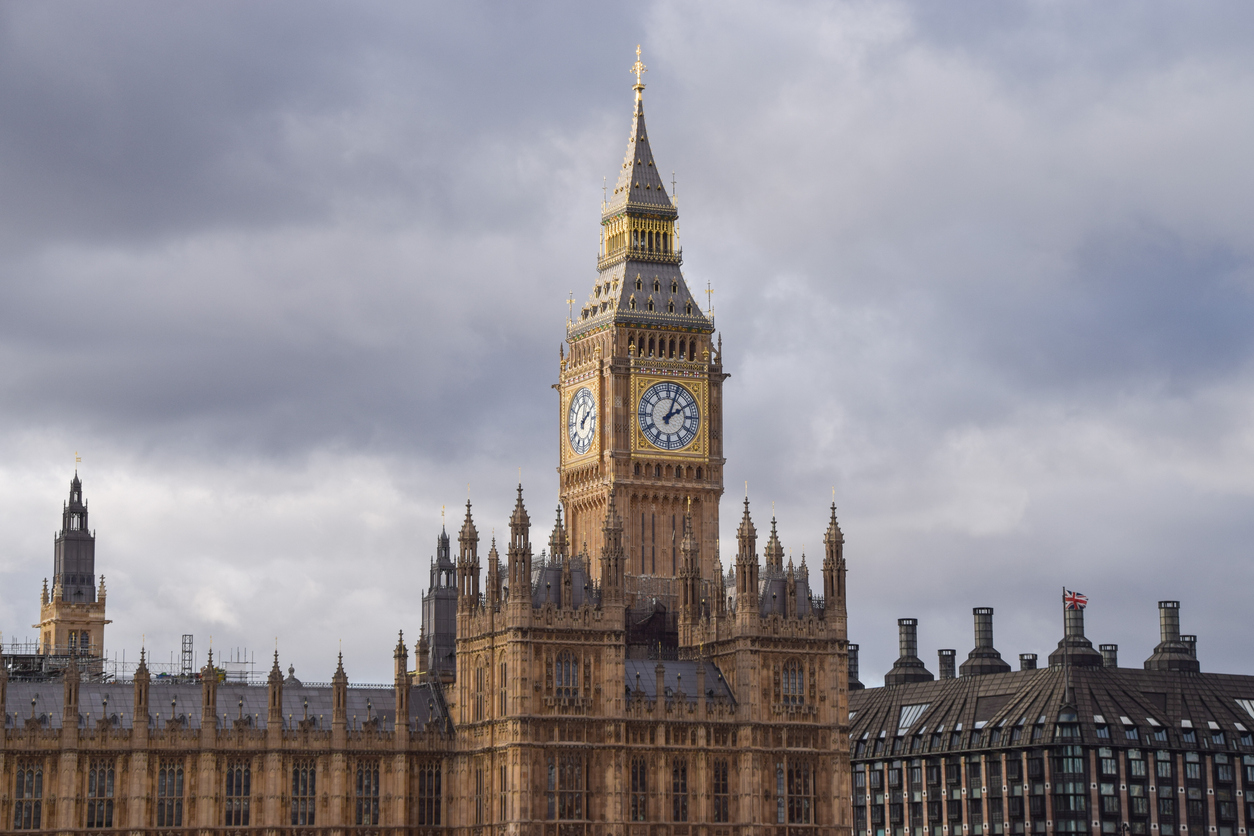
MI5 is based at Thames House on Millbank, not far from the Houses of Parliament.
The agency is based on the opposite side of the River Thames from MI6. MI6 is located in a more distinctive and modern building, itself previously featured in the James Bond film, Skyfall.
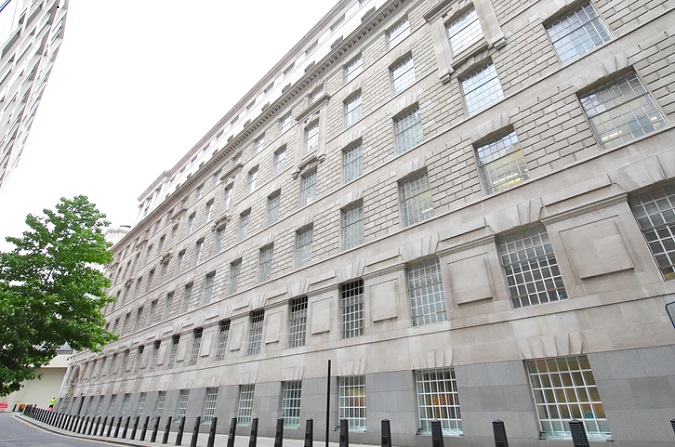
MI5’s headquarters in London
Who runs MI5?
- MI5 is a government department under the authority of the Home Secretary. The UK’s two other intelligence agencies (SIS (MI6) and GCHQ) operate under the authority of the Foreign Secretary.
- MI5 is currently headed by its Director General, Ken McCallum. Mr McCallum grew up in Glasgow, and holds a degree in Mathematics from Glasgow University.
A long time employee of MI5, he was a former Deputy Director General of the Service, and led MI5’s response to the attempted assassination of Sergei Skripal in Salisbury in 2018.
- The Director General of MI5 is responsible for the operations and efficiency of the agency, for making sure that MI5 is politically impartial, and for obtaining information only in accordance with MI5’s statutory responsibilities and to prevent or detect serious crime.
Under the Justice and Security Act 2013 and the accompanying Memorandum of Understanding, Parliament’s Intelligence and Security Committee oversees the policies, expenditure, administration and operations of MI5, MI6, and GCHQ. The Committee consists of nine Members, drawn from both Houses off Parliament.
In April 2023, the then deputy director general of MI5, Anne Keast-Butler, was appointed as the first female director of the UK’s intelligence communications agency, GCHQ.
The history of MI5
MI5 has its origins in the Secret Service Bureau, founded in 1909 to control the UK’s intelligence activities. Originally split into naval and army sections, these branches rapidly came to focus on overseas and domestic security respectively. This division was formalised with the separation of the Secret Intelligence Service (MI6) in 1911. The “MI” designations were introduced in 1916, as the organisations transferred to the Directorate of Military Intelligence.
Highly successful in rooting out German spies in the run-up to the First World War, MI5 soon widened the scope of its attention to the pacifist and labour movements – in the belief that these groups were being manipulated by foreign provocateurs. It was also active in Ireland, although it was largely unsuccessful in infiltrating the IRA.
After the Russian Revolution of 1917, the threat posed by communism became a central focus for MI5 – leading it on occasion into sensitive political areas. The most notorious episode of this period was the “Zinoviev Letter” affair of 1924 – a letter from the head of the Comintern urging British socialists to revolt was leaked to the press, a factor which was deemed to have harmed Labour in that year’s General Election. The letter was later found to have been the work of anti-socialist elements within MI5 and MI6.
Nonetheless, MI5 was unsuccessful in preventing significant Soviet infiltration during the 1930s: the most famous case being that of the “Cambridge Five” – one of whom, Kim Philby, was a British intelligence officer himself – whose espionage for the USSR went undetected until the 1960s.
In the postwar era, MI5’s attention was firmly fixed on the USSR and its allies. The revival of Irish terrorism in the late 1960s later drew it heavily into counter-terrorism work, as well as counter-espionage. However, allegations of political subversion continued to dog the Service: the Labour prime minister Harold Wilson was convinced that MI5 was plotting against him, a claim repeated by the former MI5 officer Peter Wright in his 1987 memoir, “Spycatcher”.
Until 1989, successive governments continued to deny the existence of MI5 and its fellow intelligence agencies. The “Spycatcher” affair was therefore a considerable blow for the Service. Despite the Thatcher government’s attempts to prevent publication, the book obtained worldwide attention.
Amongst other claims, Spycatcher outlined historic allegations of incompetence in MI5, a plot to assassinate the Egyptian president Kamal Nasser, and resurrected the suggestion that the head of MI5 during the 1960s, Sir Roger Hollis, was himself a Soviet agent (officially denied by the Trend inquiry of 1974).
In the wake of “Spycatcher”, the Security Services Act 1989 formally acknowledged the existence of MI5, and the Intelligence Services Act 1994 established the Parliamentary Intelligence and Security Committee to reinforce Parliamentary accountability.
The 1989 Security Service Act defined the remit of MI5 as, “the protection of national security and in particular its protection against threats such as terrorism, espionage and sabotage, the activities of agents of foreign powers, and from actions intended to overthrow or undermine parliamentary democracy by political, industrial or violent means”.
Under the leadership of a more recognizable director-general, Stella Rimington, MI5 began to move out of the shadows. Its surveillance work became subjected to the scrutiny of the Interception Commissioner under the Regulation of Investigatory Powers Act 2000.
With the collapse of the Soviet Union in 1989 and the decline of Irish terrorism in the mid-1990s (due in part, many argue, to the successes of MI5), the agency’s principal focus had been considerably diminished.
As a result, in 1996, MI5 expanded its remit into intelligence work relating to conventional criminal activity – a substantial change in its role, and one which many condemned as turning the organisation into a de facto “secret police force”.
MI5 was shaken again in 1997, when another former officer, David Shayler published allegations of incompetence and of an MI6 plot to assassinate Libyan leader Colonel Gadaffi. Once again, the Government’s attempts to silence Shayler – efforts which culminated in demands that he be extradited from France – raised the profile of his claims considerably. In November 2002, Shayler was sentenced to six months imprisonment for breaching the Official Secrets Act.
In the aftermath of the terrorist atrocities in New York in September 2011, and with the emergence of international terrorism as a major concern for Western governments, MI5 has found a new focus of attention. Its experience in combating the IRA has been said to be useful in addressing the modern terrorist threat, whether from Islamist or far right extremists.
The MI5 website details how, at any one time, MI5 and the police are conducting around 500 active counter terrorism investigations involving 3,000 subjects of interest. In addition to this, it suggests that there are around 20,000 individuals who have been subjects of interest in previous terrorism investigations. It is claimed that MI5, the police and partners stopped 18 terrorist plots in Great Britain between 2013 and 2017.
In 2020, the Daily Mirror newspaper claimed that there were 700 live probes into terror plots being investigated by MI5 and the police, and that there were 23,000 individuals on file as being possible jihadists. It was suggested that at least 20 known jihadis are being tracked every day by police and MI5 to stop bloodshed on the streets.
- In April 2020, MI5 took primacy for Right Wing Terrorism (RWT) and Left, Anarchist and Single-Issue Terrorism (LASIT).
In light of the developments in Information and Communications Technology in the Twenty First Century, in recent years, MI5 has also become more active in combating cyber threats against the UK. These include threats from foreign states, criminals, “hacktivist” groups and terrorists.
MI5 also works to prevent the proliferation of weapons of mass destruction (WMD), including nuclear, biological and chemical weapons.
In January 2022, MI5 was behind a so called Chinese ‘interference alert’ that related to the activities of Christine Lee, a lawyer in London who was said to be an agent working covertly for the Chinese government. It was claimed that the office of the Labour MP, Barry Gardiner, had received some £584,177 of donations from Lee.
- The then Home Secretary, Priti Patel, said it was “deeply concerning” that someone “who has knowingly engaged in political interference activities on behalf of the Chinese Communist Party has targeted parliamentarians”.
Controversies
Most states maintain a secret intelligence service, but their existence is always problematic for open democratic states, particularly in the age of mass media. The openness required in democratic societies is necessarily at odds with the secrecy of intelligence agencies. As such, revelations about their work has often been a cause of public scandal.
Allegations about MI5’s activities in much of the recent past remain necessarily contentious with the suggestion that MI5 had historically operated outside the law. Where such instances have come into the open, the culprits have usually been dismissed as “rogue” elements. Today, MI5 has a public commitment to “legality; integrity; objectivity; a sense of proportion about our work; and respect and consideration for each other and for those with whom we work outside the Service”.
The agency has long had an ambiguous relationship with the Labour Party and the left in general. One of the revelations contained in David Shayler’s book was that MI5 had maintained files on leading Labour politicians, including Jack Straw and Peter Mandelson. Part of that perceived hostility is widely believed to stem from MI5’s position at the heart of the “Establishment”. In July 2006, the then Liberal Democrat MP, Norman Baker accused the British Government of “hoarding information about people who pose no danger to this country”, after suggestions that MI5 held secret files on 272,000 individuals, equivalent to one in 160 adults.
In response to these kind of claims the MI5 website takes a robust approach, claiming:
“We have never investigated people simply because they were involved with trade unions or campaigning organisations. The Security Service Act 1989 requires us to be politically neutral and not act for the benefit of any political party. We only investigate matters that affect national security, within the remit set out in the Act”.
MI5’s move into the field of conventional crime under the Security Services Act 1996 was also a highly contentious development. Unlike the police and other criminal investigation bodies, MI5 had little experience of working in the open, and had previously had little focus on obtaining convictions. This lack of organisational fit, concerned many at the time, with suggestions that the agency was being engaged as a “secret police force”.
MI5 maintains that it only becomes involved in criminal investigations when tasked to do so by another law enforcement agency, which hopes to benefit from its intelligence expertise. The Service states that most of the work it has done in this regard has been in relation to drug trafficking.
It is necessarily difficult to know precisely what a secret intelligence agency does. MI5 and the Government insist that the Security Service acts only in line with the remit outlined in the Security Services Act, and that recent reforms have rendered it fully politically and judicially accountable. Many, however, still raise questions in this regard.
Most recently MI5 has had to refute allegations that it was complicit in acts of torture carried out in the aftermath of 9/11 on terrorist suspects detained abroad. In July 2010 the Prime Minister, David Cameron, announced that a non-statutory inquiry would be established to examine whether, and if so to what extent, the UK’s government and intelligence agencies were involved in improper treatment of detainees held by other countries.
Mr Cameron stressed that the allegations had not been proven and he praised the “tremendous acts of bravery” carried out by intelligence officers who “track terrorist threats and disrupt plots…without any public-or, often, even private-recognition, and despite the massive personal risks to their safety.” Nevertheless he said there were “questions over the degree to which British officers were working with foreign security services who were treating detainees in ways they should not have done” and that these “issues of the past” had to be resolved.
In particular claims by a former Guantanamo detainee and Ethiopian born UK resident Binyam Mohamed that an MI5 officer had been complicit in his torture in 2002 resulted in an inquiry being launched by Scotland Yard. However, in November 2010 the then Director of Public Prosecutions, and now Labour Party leader, Sir Keir Starmer, announced that there was “insufficient evidence” to prosecute the officer.
In 2015 it was suggested that MI5 had paid UK Muslims as much as £2,000 to spy on terror suspects, in a claim that lead to controversy around the ethics of the agency’s actions.
- It has also been claimed that the UK’s security services, including GCHQ, MI5 and MI6, have been unlawfully collecting and using mass datasets of personal information for over a decade, doing so in a way that did not comply with the right to privacy (Article 8) in the European Convention on Human Rights. Privacy International, a civil liberties group which took the action to court, said the ruling was “highly significant” and it confirmed the bodies were “secretly spying on a massive scale”.
- In March 2023, MI5 apologised for not preventing the 2017 suicide bombing at Manchester Arena which led to the murder of 22 people. It was reported that MI5 had received intelligence in the months before the 2017 attack, linking the bomber, Salman Abedi, to a possible bomb plot. The BBC have claimed that the information was assessed as unreliable.
- Quotes
“In back rooms and in cars and on the streets of this country there is no shortage of individuals talking about wanting to mount terrorist attacks here. We see them regularly in our intelligence investigation”…”And others in various parts of the world have the same ambitions.” – MI5 director-general Jonathan Evans, June 2012
“MI5’s work has been depicted in a number of films and TV series, notably the BBC’s ‘Spooks’ (“MI-5” in the United States). Such works of spy fiction glamorise the world of intelligence and, although they’re entertaining, they tend not to be very realistic”… “Our work can certainly be stimulating and highly rewarding. However, in real life a large percentage of our work is routine and painstaking (though vitally important) and wouldn’t be at all entertaining to watch. More importantly, unlike our fictional counterparts we work within the law. All of our operations are carried out within a legal framework and with careful risk management and oversight” – MI5 Website.
Review: Inside British Intelligence: 100 Years of MI5 and MI6