Overview
The Welsh Government (sometimes referred to as the Welsh Executive, Welsh Assembly Government or the Welsh Cabinet) is formed by the party or parties with the majority of seats in the Senedd Cymru (formerly known as the National Assembly of Wales).
Current Welsh Government
The Assembly Government is made up of the First Minister and eight Welsh Ministers (sometimes called Assembly Secretaries).
Each is responsible for a particular area of policy. The First Minister chooses which AMs become Ministers from the ruling party or parties.
The current Welsh Cabinet is:
First Minister of Wales – Mark Drakeford
Minister for the Constitution – Mick Atoniw
Minister for Finance and Local Government – Rebecca Evans
Minister for the Economy – Vaughan Gething
Minister for Education and Welsh Language – Jeremy Miles
Minister for Health and Social Services – Eluned Morgan
Minister for Social Justice – Jane Hutt
Minister for Rural Affairs and North Wales – Lesley Griffiths
Outside of the Welsh Cabinet, junior Ministers in the Welsh government include:
Deputy Minister for Arts and Sport, and Chief Whip – Dawn Bowden
Deputy Minister for Social Partnership – Hannah Blythyn
Deputy Minister for Climate Change – Lee Waters
Deputy Minister for Social Services – Julie Morgan
Deputy Minister for Health – Lynne Neagle.
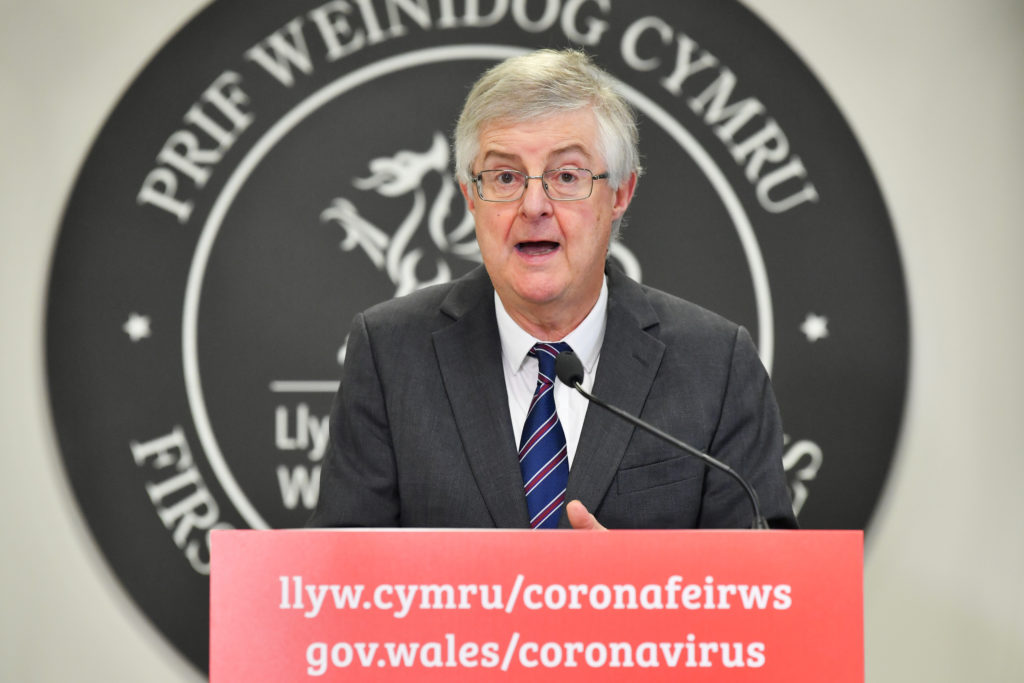
First Minister Mark Drakeford
Funding of the Welsh Government
The work of the Assembly Government is funded by the grants formerly provided to the Secretary of State for Wales.
The ‘Barnett formula’ is used to share out increases in UK public expenditure between the constituent parts of the UK (not Northern Ireland). This complex formula was first used in the late 1970s by then Chief Secretary to the Treasury Joel (now Lord) Barnett. Put simply, certain increases in UK-wide expenditure are divided up according to population, which means that historic additional per capita spending in Wales tends to be preserved.
Appointment of the Welsh Government
The First Minister (sometimes referred to as the First Secretary) is elected by Senedd Members (AMs) and, as such, is normally the leader of the largest party.
Because the electoral system used for AMs makes an overall majority for one party unlikely, the First Minister is normally elected by a coalition of parties that have agreed to form the Assembly Government.
This coalition would normally include the largest party. For example, in 1999 the First Welsh Assembly Government was formed by Labour and the Liberal Democrats with a Labour First Minister.
Secretary of State of Wales
Following devolution the Welsh Office became the Office for the Secretary of State for Wales.
The Secretary of State for Wales, is appointed by the Prime Minister, and normally is a Welsh MP that sits for the government party at Westminster. He or she sits in the Cabinet in London.
The Secretary of State for Wales exercises the following functions:
Ensuring Welsh interests and needs are considered in policy formulation and consulting with the Assembly on forthcoming legislation
Ensuring the smooth running of devolution through membership of the joint Ministerial Committee that links the UK Government with Welsh Ministers
Responsibility for primary legislation on Wales, including Wales-only clauses of other Bills
Transfer of funds from the Treasury to the Assembly
Accountability to Westminster for Welsh issues; monthly oral question session