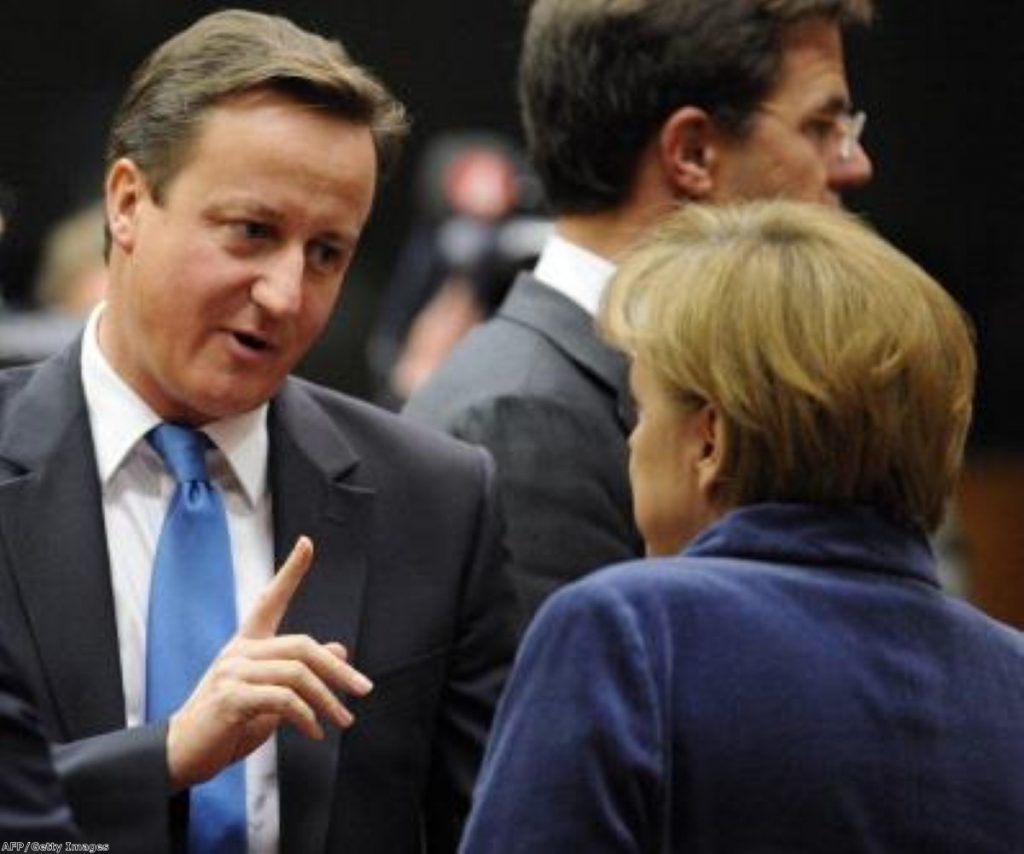
Cameron gazes into the eurozone abyss
David Cameron has voiced the possibility of the eurozone falling apart, just days after George Osborne warned speculation about Greece was damaging Europe.
The prime minister raised eyebrows yesterday when he said the eurozone must either "make-up or break up" during PMQs, but the phrase appears to be solidifying into the government line, as he reiterated it in a speech on the economy later.
"The eurozone is at a cross-roads. It either has to make-up or it is looking at a potential break-up," he said.
"Either Europe has a committed, stable, successful eurozone with an effective firewall, well capitalised and regulated banks, a system of fiscal burden sharing, and supportive monetary policy across the Eurozone.


"Or we are in unchartered territory which carries huge risks for everybody.
"Be in no doubt: whichever path is chosen, I am prepared to do whatever is necessary to protect this country and secure our economy and financial system.”
Moments after the speech it emerged Mr Cameron would take part in a video conference call with other European leaders, including Angela Merkel, Francois Hollande, Mario Monti, Herman Van Rompuy and José Manuel Barroso.
The comments come amid continued instability in Greece, with the country going to the polls again June 17th after the various political parties failed to form a government. Far-left anti-austerity bloc Syriza is predicted to come first.
Panagiotis Pikrammenos, a 67-year-old senior judge, will lead the country as head of a technocrat government until the next election.
Mr Cameron's speech comes just two days after Mr Osborne warned against speculating on Greece's future.
"It is the uncertainty that is causing the damage," the chancellor said.
"Of course countries have got to make difficult decisions about their own public finances… but it's the open speculation from some members in the eurozone about the future of some countries in the eurozone which I think is doing real damage across the whole European economy."
Speaking in the Commons today, Mr Osborne played down the contradiction, saying: "When eurozone central bank governors and finance ministers openly speculate on the possibility of Greek exit, then the genie is out of the bottle."
Elsewhere in the speech, Mr Cameron reiterated his pledge to protect Britain from the European crisis.
“We are living in perilous economic times," he said
"Turn on the TV news and you see the return of a crisis that never really went away: Greece on the brink…the survival of the euro in question.
"Faced with this, I have a clear task: to keep Britain safe."
Yesterday saw a fall in unemployment, but optimism was dampened by Bank of England forecasts revising UK growth downwards.
Shadow chancellor Ed Balls attacked the speech, pointing out that countries like France and germany had avoided a double-dip recession despite being in the eurozone.
"David Cameron must recognise the austerity policies which are failing in Europe are the very same policies that have failed in Britain and which the British government has been urging eurozone countries to stick with," he commented.
"And instead of using the eurozone crisis as an excuse for Britain's problems David Cameron must wake up to the fact that our economy has not grown for over a year and a half on his watch. When countries like France and Germany have avoided recession, despite the eurozone's problems, it's clear Britain's double-dip recession was made in Downing Street."
Downing Street feels it has won the argument on the deficit but is losing the argument on growth, especially after the UK went back into recession.
The election of French Socialist Francois Hollande in a campaign focused on growth has jolted Mr Cameron, who will argue in his speeech that deficit reduction is a pre-condition of economic growth.
Nerves across Europe have been heightened by the chaos in Greece, with analysts trying to assess the risk of contagion if it were to fall out the eurozone.
"We need to get the risks in perspective," business secretary Vince Cable said.
"There clearly are risks to the UK. Greece itself is a small country, it's only two per cent of the European economy. The risks arise if the crisis were spread to other weaker, countries in southern Europe, but there is no reason why that should happen. They are in the process of creating firewalls to prevent the financial crisis spreading and we hope that they do."
Former chancellor Lord Lamont said: "The immediate effects of a Greek departure don't go to this country but they would reach us indirectly. The worst effects are on the banking system, first on the Greek banks, but then on French banks that have lent to Greece, and then British banks that have lent to France, so indirectly we are involved.
"But the most damaging thing I think is this corrosive effect on confidence."