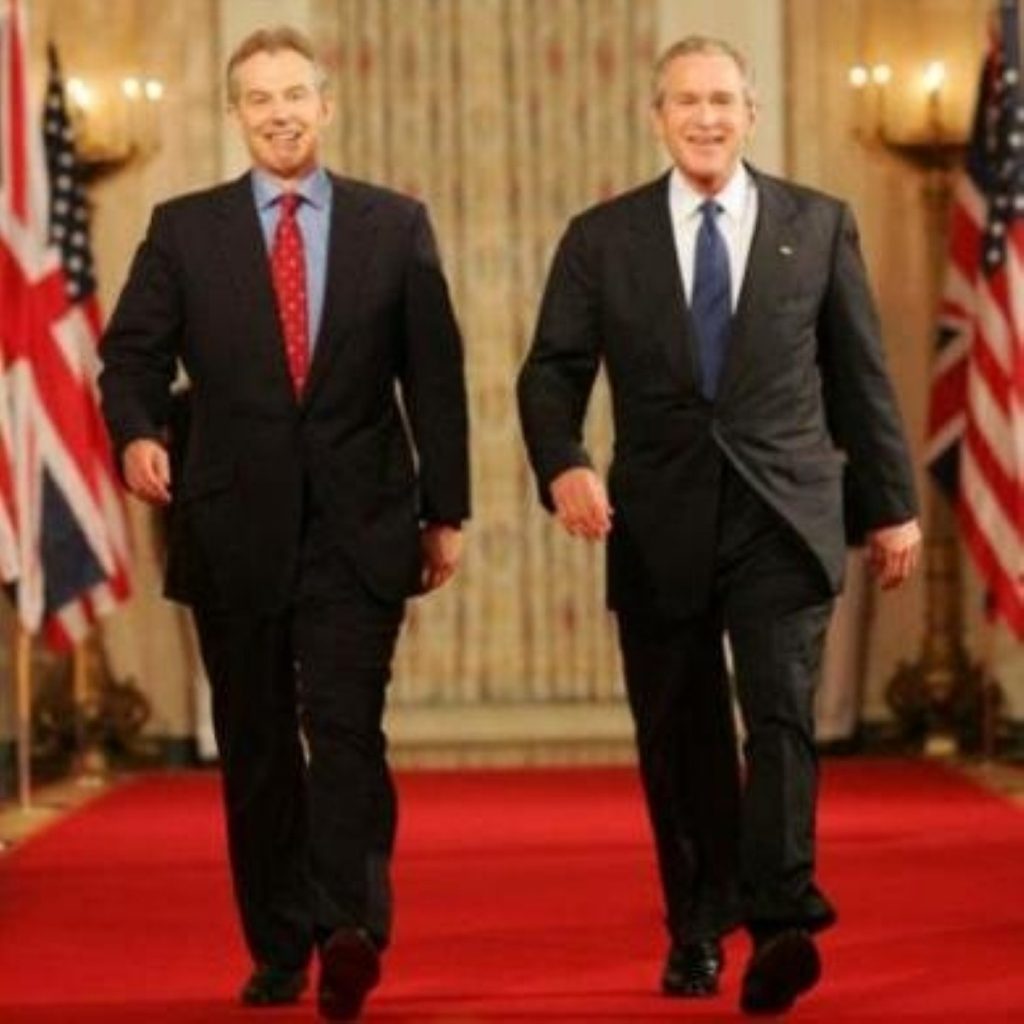
Blair ‘has followed Bush into foreign failures’
Tony Blair’s “inability” to influence the Bush administration is behind the foreign UK’s policy failures, a new report has found.
Despite the military, political and financial expense the Labour government has incurred supporting the US president, loyalty has counted for little, the Chatham House think tank has concluded.
And Mr Blair’s successor as prime minister will not make “the same mistake” of giving the US unconditional support in foreign policy initiatives at the expense of relationships with Europe, predicts Chatham House’s Blair’s Foreign Policy and its Possible Successor(s) report.
The government has rejected Chatham House’s conclusions, describing the report as “just plain wrong”.


Professor Victor Bulmer-Thomas, author of the report, finds that Mr Blair’s foreign policy during his first term in office (1997-2001) was a “qualified success”, with Labour demonstrating Britain’s credentials within the European Union while still managing a close working relationship with the Clinton administration.
But failure to see the consequences of the Taliban resurgence in Afghanistan was “unforgivable”, and failure to coordinate Europe’s response to the US war on terror was “regrettable”, the new report concludes.
But the root cause of foreign policy failures is the government’s “inability to influence the Bush administration in any significant way”.
However, foreign secretary Margaret Becket roundly rejected the conclusions of the report, saying: “This paper is threadbare, insubstantial and just plain wrong.
“Chatham House has established a great reputation over the years, but this paper will do nothing to enhance it.”
Chatham House director Professor Bulmer-Thomas had heavily criticised British foreign policy under the Labour government.
“Despite a number of successes, especially in his first term, Tony Blair’s time in office will be overshadowed by the disaster in Iraq,” he said at the report’s launch.
“The recent findings of the Iraq Study Group indicate that a shift in US policy is imminent and part of the UK’s response to this shift should be to forge a common European response or risk isolation on the international stage.”
Since the Iraq “debacle” the government’s European policy has been one of damage limitation, Chatham House’s report finds, but challenges remain for Mr Blair’s possible successors as prime minister – Gordon Brown and David Cameron.
Mr Brown has “strong Atlanticist leanings” and has been critical of “lagging eurozone [economic] performance”, the report finds, while the Tory leader has “already indicated his preference to align with eurosceptic European parties”, the report states.
But moving closer to Europe will be a “requirement” despite current British influence being limited and the British public “uncomfortable in its European skin”.
“A distancing of the UK from the US and a closer relationship with Europe are requirements of post-Blair foreign policy,” Chatham House finds.
“However, the UK will have to work to be taken more seriously by its European partners. This will require the UK to rethink its opposition to joining both the Schengen agreement [on border controls] and the eurozone.”
And the UK should forge a closer relationship with Spain as part of its European strategy, to balance Franco-German influence on the EU, the report concludes.
But in reviewing Mr Blair’s time in office there were successes in foreign policy.
The prime minister’s “undoubted powers of persuasion” have been effective in pushing climate change up the international agenda, while the UK can also claim success for Libya’s decision to abandon its nuclear weapons programme, the report finds.