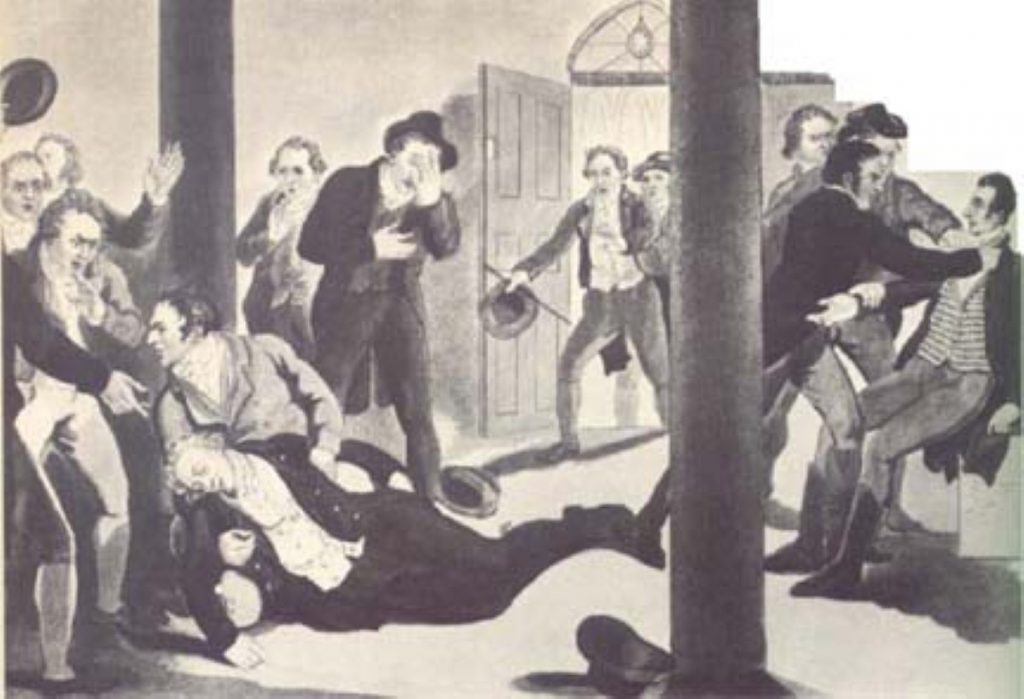
May 11th 1812: The untimely death of prime minister Spencer Perceval
By Oliver Hotham
The prime minister is unpopular at the moment, there's no doubt about it. A bad Budget, a double dip recession, and allegations that he's a 'posh boy' who 'doesn't know the price of milk' all tend to stick to you in a bad way.
In situations like this, the British public have a great many ways of expressing their discontent with the head of Her Majesty's government. They can give the government a bashing in local elections, write indignant letters to sympathetic tabloids, or even take to the streets with placards and slogans. All are peaceful and legitimate ways to give the PM a telling off, to let him know that, despite his station, it is you, the citizen, who is really in charge.
May 11th marks the 200th anniversary of the last British citizen to take things a little further – the anniversary of the assassination of Spencer Perceval , who was shot by a disgruntled member of the public in the lobby of the house of commons.


Perceval was a relatively popular chap, too. He was, like Mr Cameron, a moderate Tory dealing with economic problems at home. He opposed Catholic emancipation, Lords reform and supporting war against Napoleon and the abolition of the slave trade. A pious man, he drank rarely and enjoyed spending time with his 12 children. He also had to deal with the increasingly mad George III. Constitutional crisis meant he struggled to retain support for his government in the House of Commons, and was only just beginning to build more support and popularity when he was killed.
So why was he assassinated on that fateful day two hundred years ago? In truly English fashion, it was not over some grand political dispute, his assailant did not shout "sic semper tyrannus" and make a dramatic exit. Instead he died over a failed compensation claim.
Lowly merchant John Billingham had been unjustly imprisoned in Russia and, when he returned, felt he was entitled to compensation from the British government. To his outrage, the Foreign Office refused his claim. A civil servant told him he was "at liberty to take whatever measures he thought proper" – something you should never say to a person wrangling with bureaucracy.
Billingham was already formulated a plan of his own. Having bought two pistols and a special coat to conceal them, he went into parliament and waited in the lobby for the PM. When Perceval appeared, Billingham shot him through the heart, then calmly sat on a bench.
Spencer Perceval died instantly, the only prime minister to have been successfully assassinated.
At his trial at the Old Bailey, Billingham declared that he had done no wrong, saying: "I demand only my right, and not a favour; I demand what is the birthright and privilege of every Englishman. Gentlemen, when a minister sets himself above the laws, as Mr Perceval did, he does it as his own personal risk. If this were not so, the mere will of the minister would become the law, and what would then become of your liberties?"
Perceval was mourned deeply. A witness to the trial of Billingham said that "Perceval was an exceedingly popular leader. The judge in the case literally wept as he made his closing remarks to the jury". MPs from both parties paid tribute to Perceval. Poems hailed him as a man whose piety and good character meant that even those who disagreed with him politically loved and respected him. It's doubtful that anyone would be able to say that of Cameron – even his backbenchers don't like him very much.
So what can we learn from the untimely death of Spencer Perceval? We've had far more unpopular prime ministers since him and, while there have been attempts, none have been successful. Perhaps they were never unpopular enough, or the individual's grievances big enough. Maybe assassinating the prime minister just isn't a very British thing to do.
Billingham's crime does seem to belong to a bygone era. Walk into parliament with two guns in your jacket nowadays and you won't get very far.